iptv-api
Tutorial
| 中文 | English |

⚡️ IPTV live-source automatic update platform — 🤖 fully automated collection, filtering, speed-testing, and generation 🚀. Supports extensive personalized configuration; paste the resulting address into a player to watch.
There are four installation and running methods in total (Workflows, Command Line, GUI, Docker). Choose the one that suits you.
Workflow deployment
Use GitHub Actions workflows to deploy and manually trigger the update endpoint.
[!IMPORTANT] Because GitHub resources are limited, workflow updates can only be triggered manually. If you need frequent updates or scheduled runs, please deploy using another method.
Enter the IPTV-API Project
Open https://github.com/Guovin/iptv-api and click Star to favorite this project (Your Star is my motivation for
continuous updates).

Fork
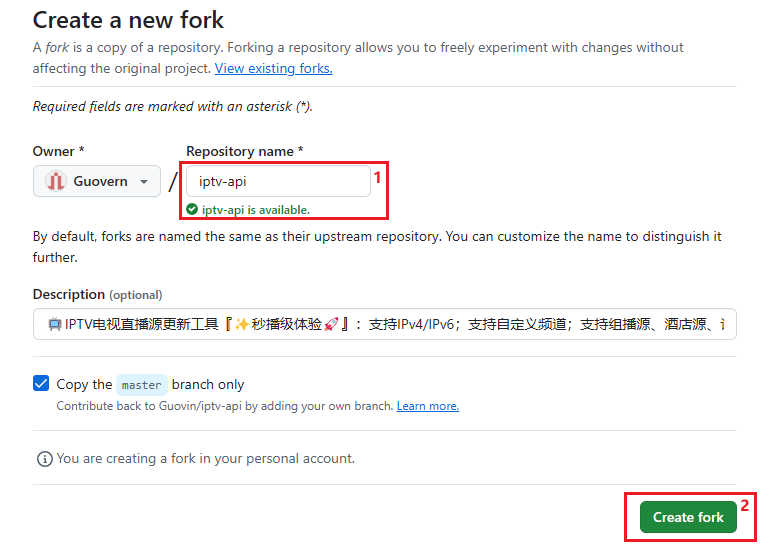
Copy the source code of this repository to your personal account repository.

- Name your personal repository as you like (the final live source result link depends on this name), here we use the
default
iptv-apias an example. - Confirm the information is correct and click to create.
Update Source Code
Since this project will continue to iterate and optimize, if you want to get the latest updates, you can do the following:
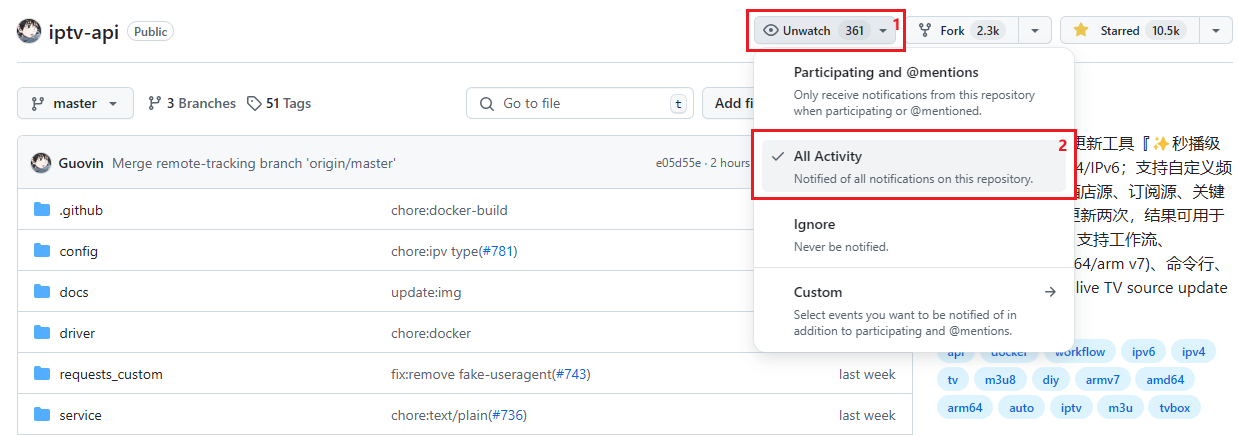
1. Watch
Follow this project, and subsequent update logs will be released as releases, and you will receive email
notifications.
2. Sync fork
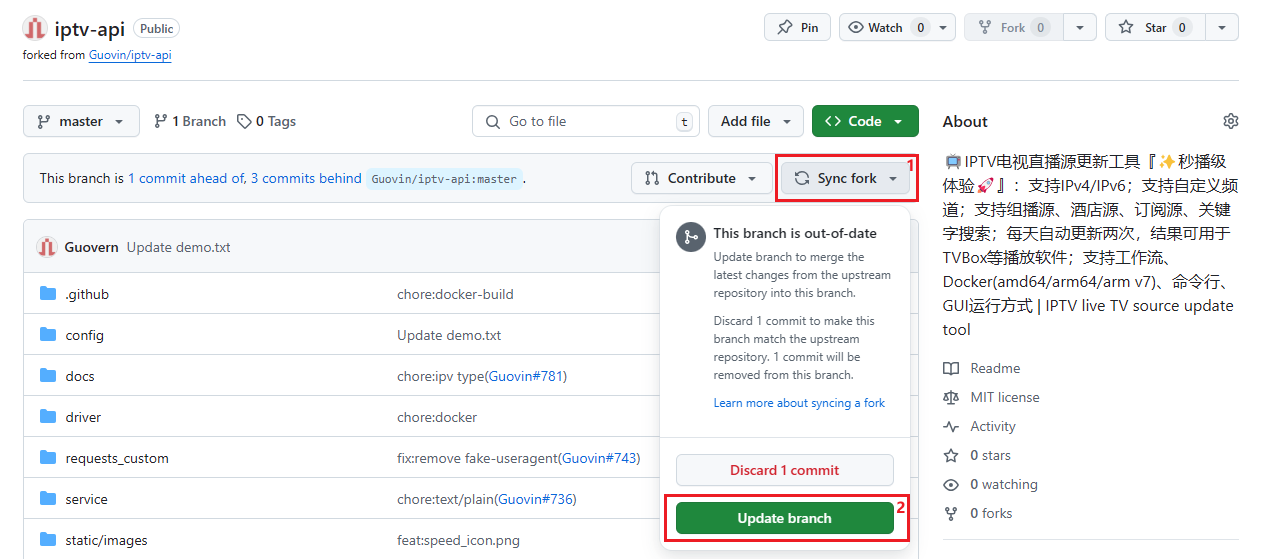
- Normal update:
Go back to the homepage of your forked repository, if there are updates, click Sync fork, Update branch to confirm
and update the latest code.
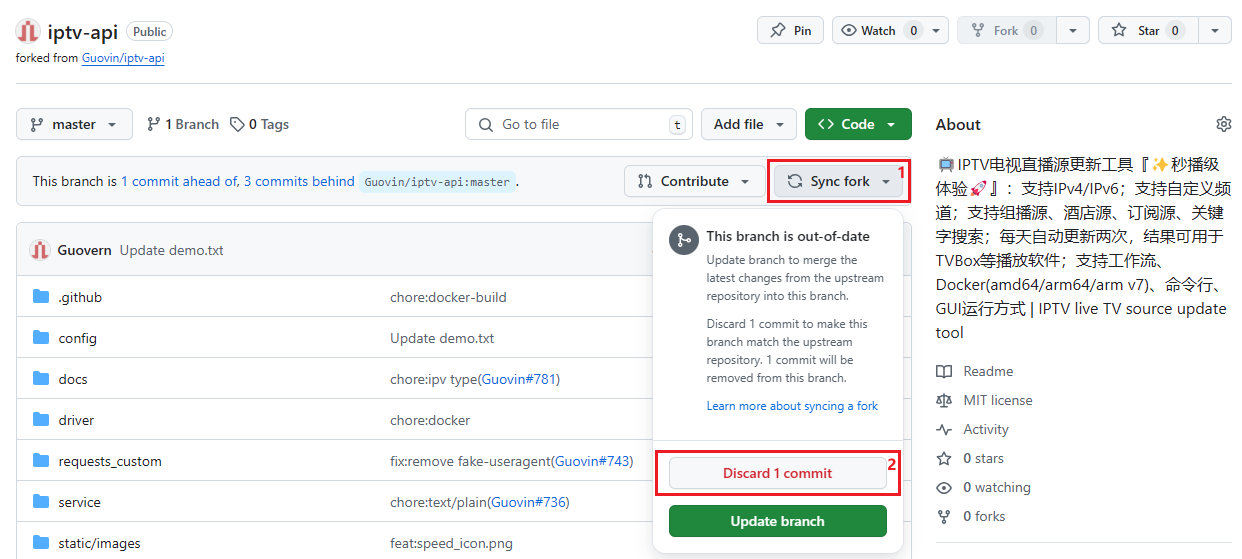
- No
Update branchbutton, update conflict:
This is because some files conflict with the default files of the main repository, click Discard commits to update the
latest code.
[!IMPORTANT] To avoid conflicts when updating the code later, it is recommended to copy files in the
configdirectory and rename them by adding theuser_prefix before modifying.
Modify Template
When you click to confirm creation in step one, you will automatically jump to your personal repository after success. At this time, your personal repository has been created, and you can customize your live source channel menu!
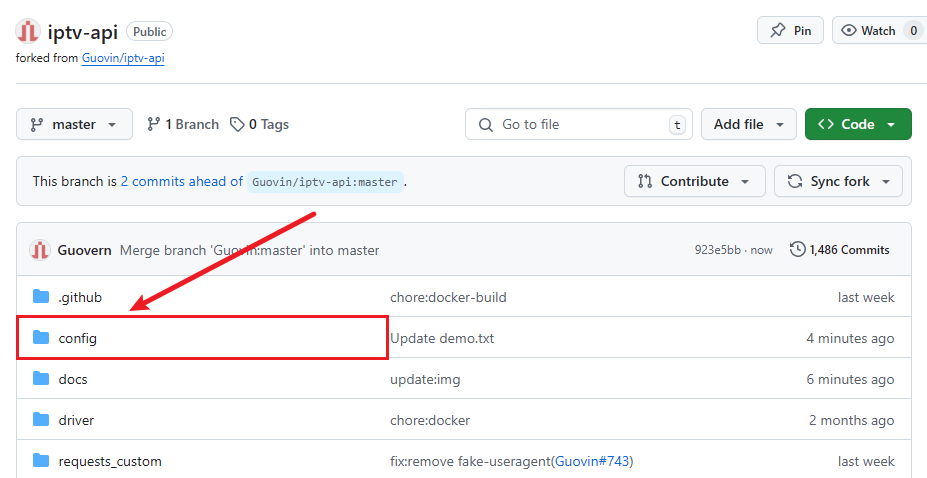
1. Click the demo.txt template file in the config folder:
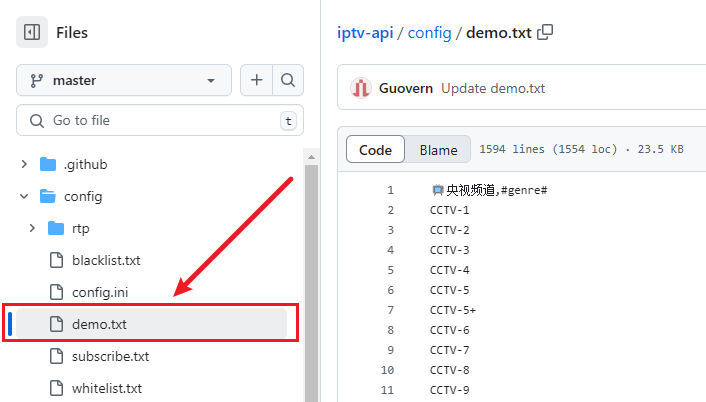
You can copy and refer to the format of the default template for subsequent operations.
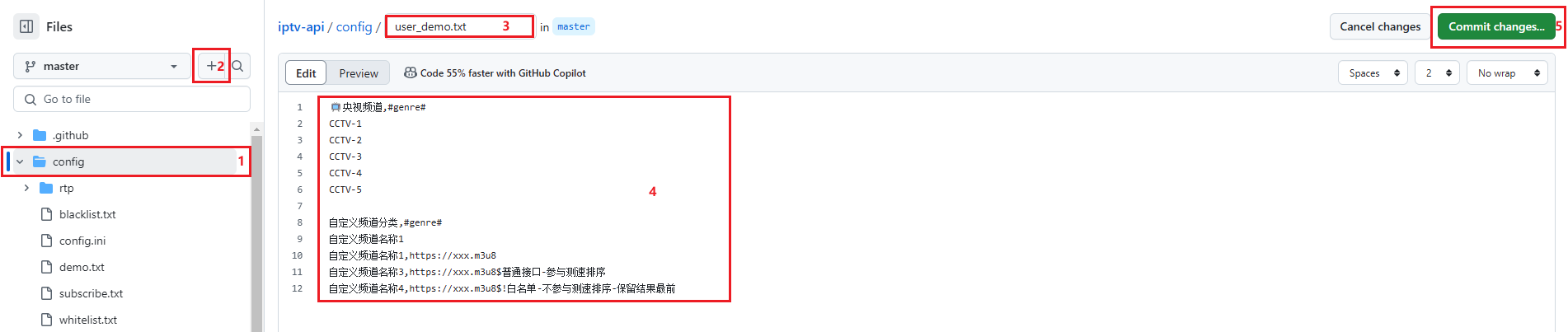
2. Create a personal template user_demo.txt in the config folder:
- Click the
configdirectory. - Create a file.
- Name the template file
user_demo.txt. - The template file needs to be written in the format of (channel category, #genre#), (channel name, channel interface)
with a comma. If you want to whitelist the interface (no speed test, keep it at the top of the result), you can add
$!after the address, such as http://xxx$!. You can also add additional information, such as: http://xxx$! whitelist. - Click
Commit changes...to save.
Modify Configuration
Like editing templates, modify the runtime configuration.
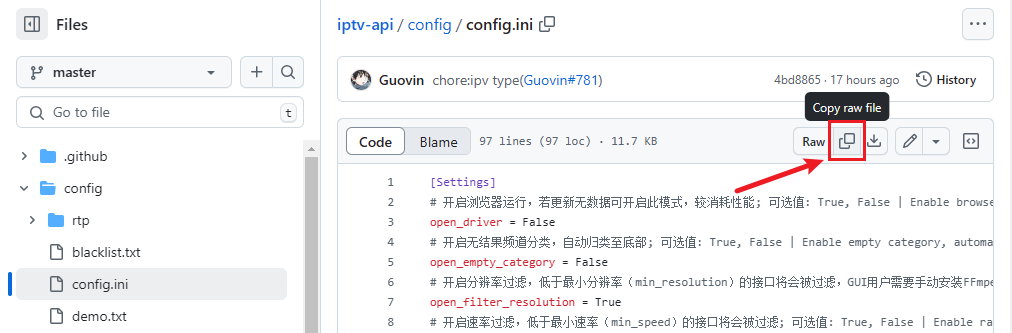
1. Click the config.ini configuration file in the config folder:
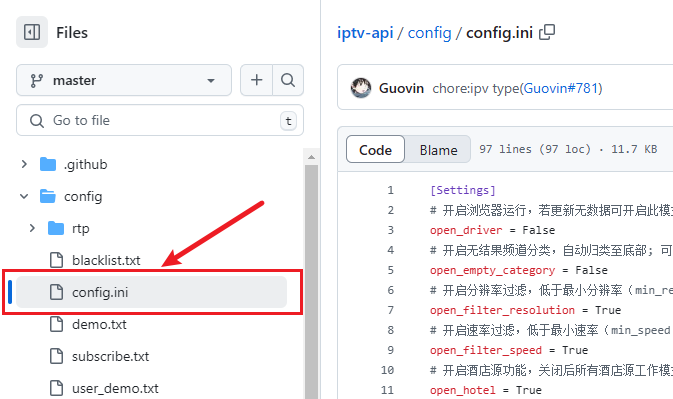
2. Copy the default configuration file content:
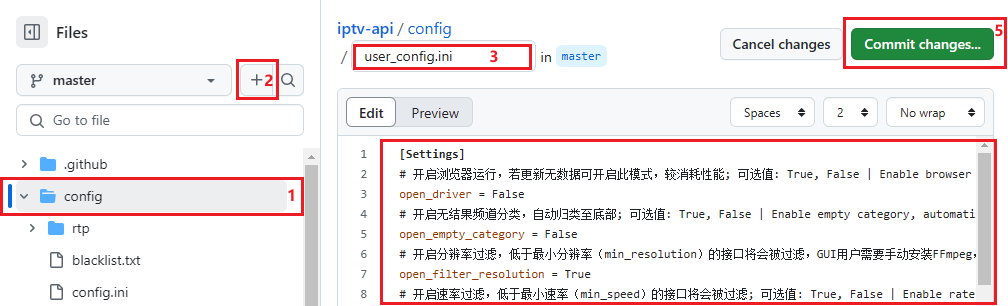
3. Create a personal configuration file user_config.ini in the config folder:
- Create a file.
- Name the configuration file
user_config.ini. - Paste the default configuration. (when creating
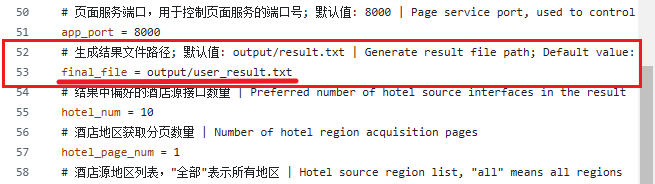
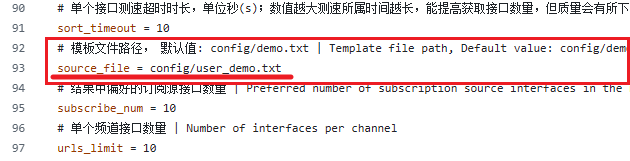
user_config.ini, you can only enter the configuration items you want to modify, no need to copy the entireconfig.ini. Note that the[Settings]at the top of the configuration file must be retained, otherwise the custom configuration below will not take effect) - Modify the template and result file configuration and CDN proxy acceleration (recommended):
- source_file = config/user_demo.txt
- final_file = output/user_result.txt
- cdn_url = (go to the
Govinpublic account and replycdnto get it)
- Click
Commit changes...to save.
Adjust the configuration as needed, here is the default configuration description: Configuration parameters
[!NOTE]
- For enabling interface information display, since some players (such as
PotPlayer) do not support parsing interface supplementary information, causing playback failure, you can modify the configuration:open_url_info = False( GUI: uncheck display interface information) to disable this feature.- If your network supports IPv6, you can modify the configuration:
ipv6_support = True(GUI: CheckForce assume the current network supports IPv6) to skip the support check.
Add data sources and more
-
Subscription sources (
config/subscribe.txt)Since no default subscription addresses are provided, you need to add them yourself; otherwise the update results may be empty. Both
.txtand.m3uURLs are supported as subscriptions, and the program will read channel interface entries from them sequentially.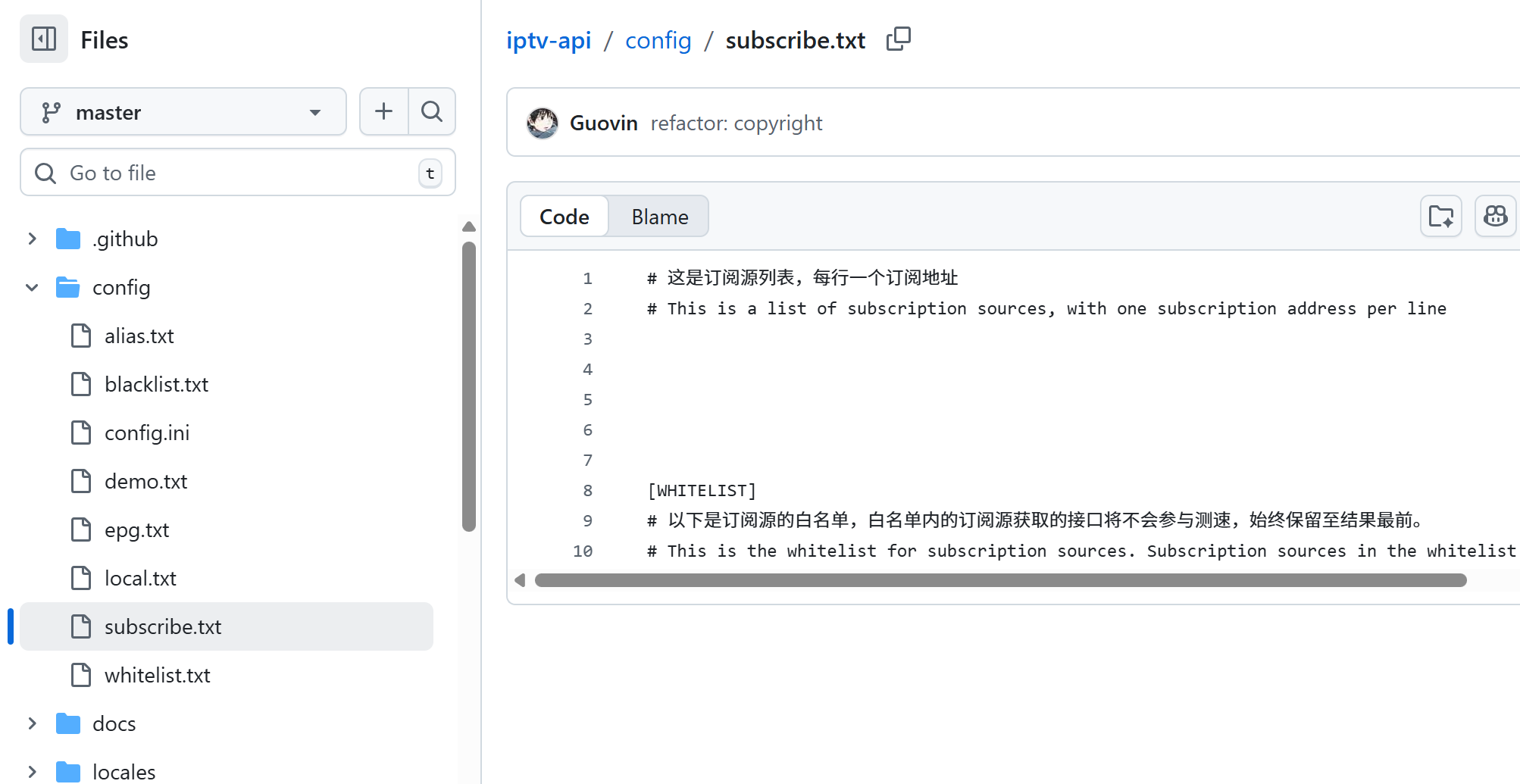
-
Local sources(
config/local.txt)Channel interface data comes from local files. If there are multiple local source files, you can create a
localdirectory underconfigto store them; the program will read the channel interface data from them in order. Supportstxtandm3ufiles. -
Logo source (
config/logo)Directory for channel logo images. The program will match corresponding logo images in this directory based on the channel names in the template. If a remote library
logo_urlis used, the remote source will be preferred. -
EPG Source (
config/epg.txt)The source of program guide information. The program will sequentially fetch the program guide data from the subscription addresses in the file and aggregate the output.
-
Channel Aliases (
config/alias.txt)A list of aliases for channel names, used to map multiple names to a single name when fetching from the interface, improving the fetch volume and accuracy. Format: TemplateChannelName,Alias1,Alias2,Alias3
-
Blacklist (
config/blacklist.txt)Interfaces that match the blacklist keywords will be filtered and not collected, such as low-quality interfaces with ads.
-
Whitelist (
config/whitelist.txt)Interfaces or subscription sources in the whitelist will not participate in speed testing and will be prioritized at the top of the results. Fill in the channel name to directly retain the record in the final result, such as: CCTV-1, interface address, only filling in the interface address will apply to all channels, multiple records are entered on separate lines.
Run Update
If your template and configuration modifications are correct, you can configure Actions to achieve automatic updates.
1. Enter Actions:

2. Enable Actions workflow:
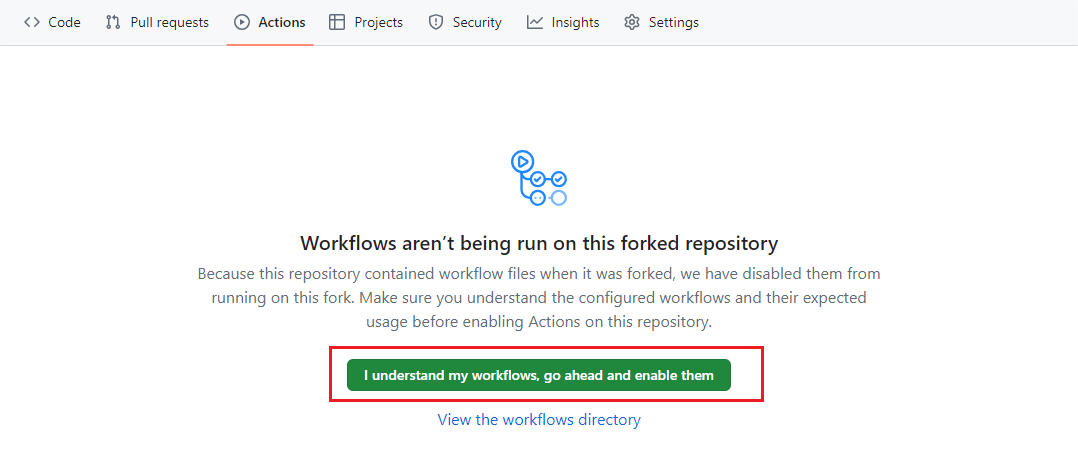 Since the Actions workflow of the forked repository is disabled by default, you need to manually confirm to enable it,
click the button in the red box to confirm enabling.
Since the Actions workflow of the forked repository is disabled by default, you need to manually confirm to enable it,
click the button in the red box to confirm enabling.
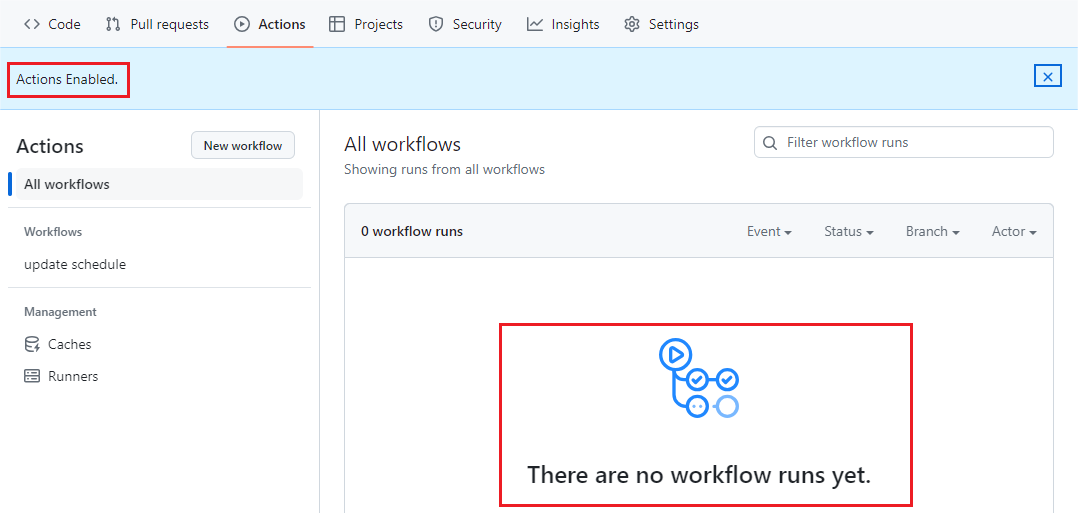 After enabling successfully, you can see that there are no workflows running currently, don’t worry, let’s start running
your first update workflow below.
After enabling successfully, you can see that there are no workflows running currently, don’t worry, let’s start running
your first update workflow below.
3. Run the update workflow:
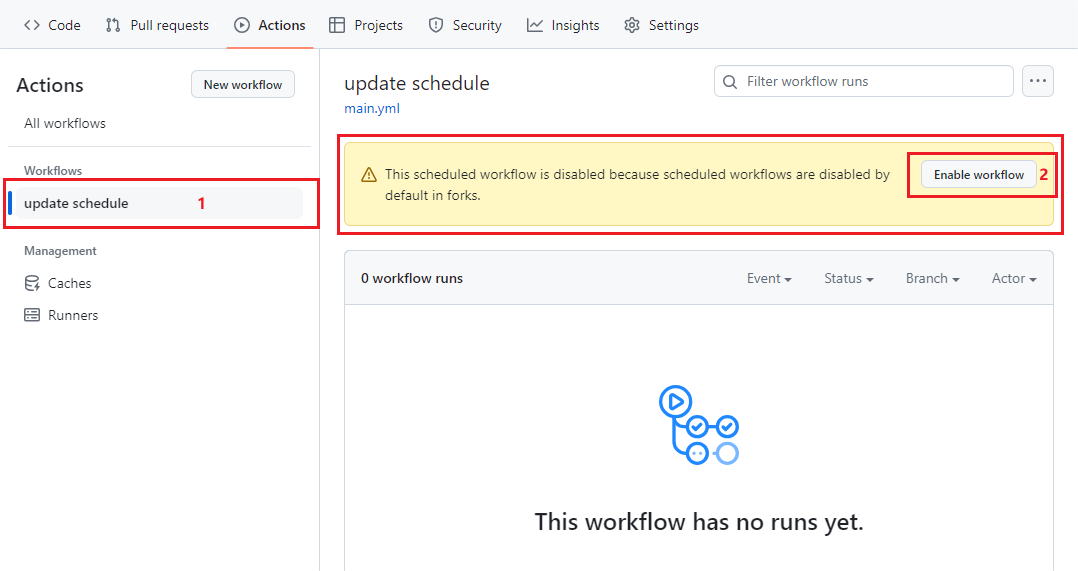
(1) Enable update schedule:
- Click
update scheduleunder theWorkflowscategory. - Since the workflow of the forked repository is disabled by default, click the
Enable workflowbutton to confirm the activation.
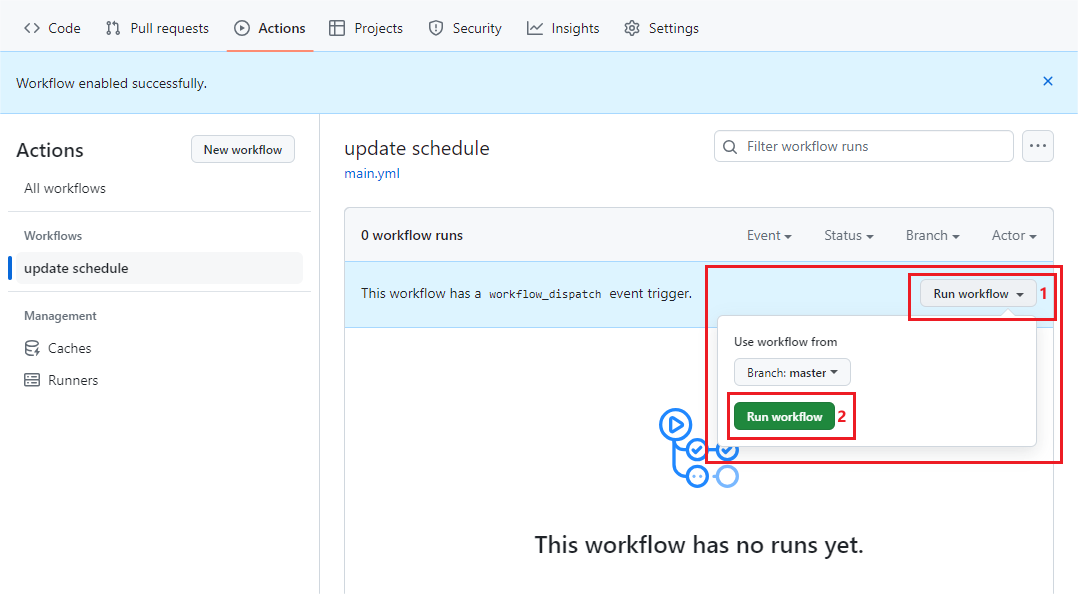
(2) Run the Workflow based on branches:
Now you can run the update workflow.
- Click
Run workflow. - Here you can switch to the branch you want to run. Since the fork defaults to the
masterbranch, if the template and configuration you modified are also in themasterbranch, just choosemasterhere, and clickRun workflowto confirm the run.
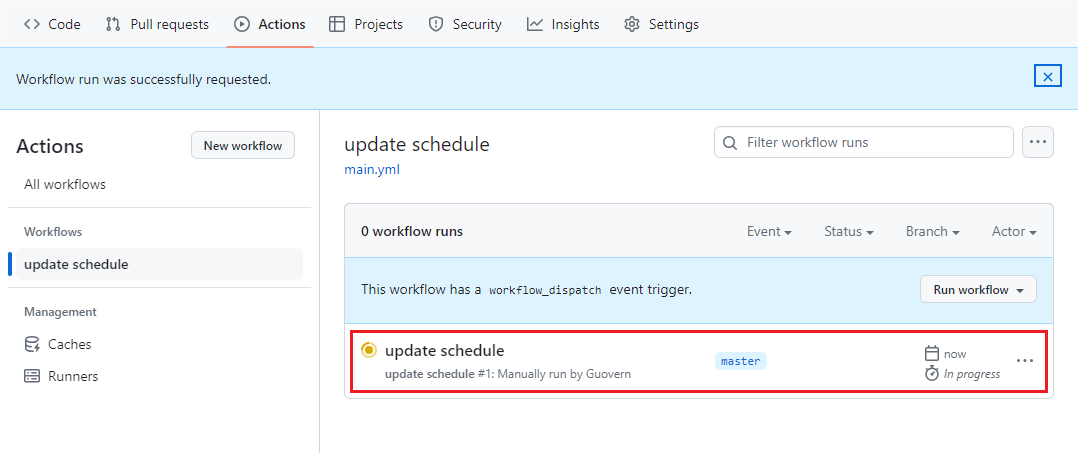
(3) Workflow in progress:
Wait a moment, and you will see that your first update workflow is running!
[!NOTE]
The running time depends on the number of channels and pages in your template and other configurations, and also largely depends on the current network conditions. Please be patient. The default template and configuration usually take about 15 minutes.
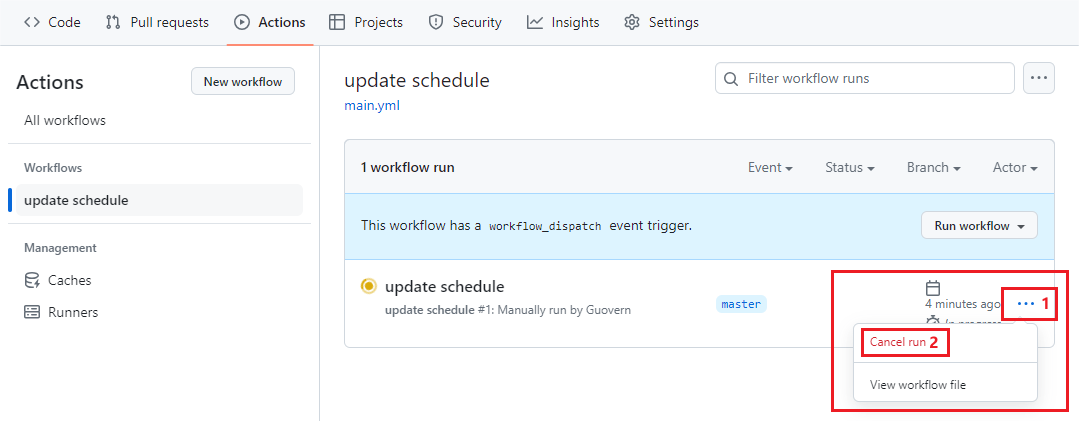
(4) Cancel the running Workflow:
If you feel that this update is not quite right and you need to modify the template or configuration before running
again, you can click Cancel run to cancel this run.
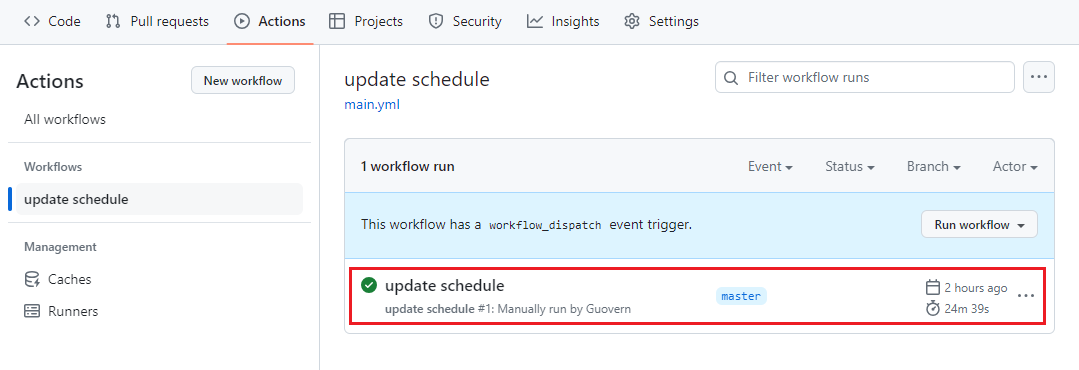
(5) Workflow executed successfully:
If everything is normal, after a short wait, you will see that the workflow has been executed successfully (green check
mark).
At this point, you can visit the file link to see if the latest results have been synchronized: https://raw.githubusercontent.com/your-github-username/repository-name/master/output/user_result.txt
Recommended CDN-accelerated URL: {cdn_url}/https://raw.githubusercontent.com/your-github-username/repository-name/master/output/user_result.txt
If you can access this link and it returns the updated interface content, then your live source interface link has been
successfully created! Simply copy and paste this link into software like TVBox in the configuration field to use~
[!NOTE]
If you have modified the template or configuration files and want to execute the update immediately, you can manually trigger (2)Run workflow.
Command Line
-
Install Python Please download and install Python from the official website, and select the option to add Python to the system environment variable Path during installation.
-
Run the update Open the terminal CMD in the project directory and run the following commands in sequence:
Install dependencies:
pip install pipenv
pipenv install --dev
Start the update:
pipenv run dev
Start the service:
pipenv run service
GUI Software
-
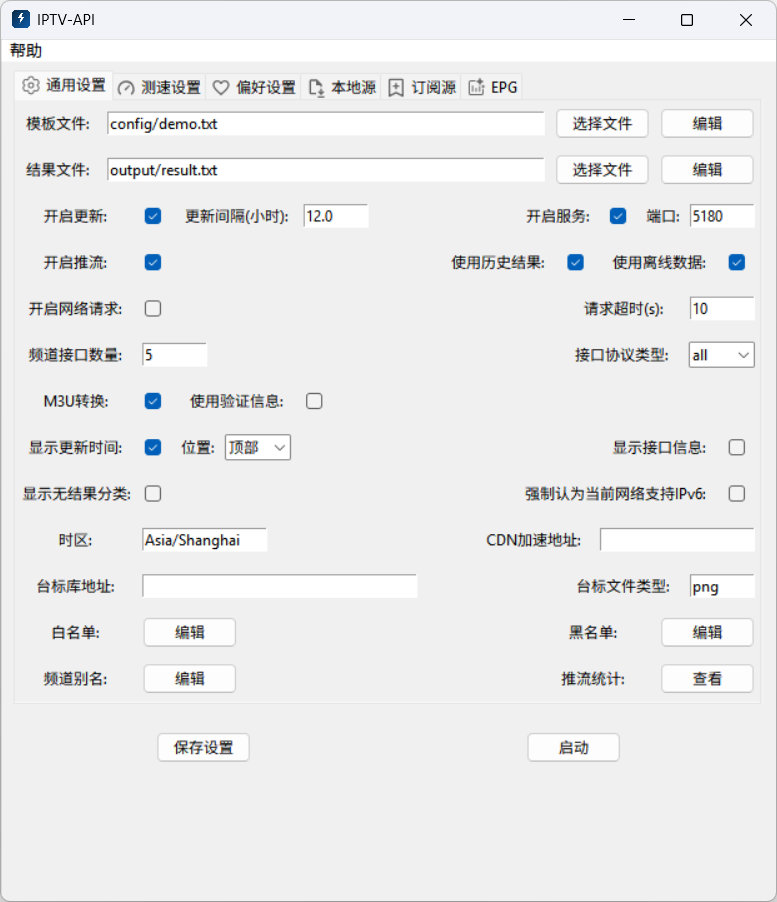
Download the IPTV-API Update Software, open the software, and click Start to perform the update.
-
Or run the following command in the project directory to open the GUI software:
pipenv run ui
Docker
1. Deployment with Compose
Download the docker-compose.yml or create one by copying the content (internal parameters can be changed as needed), then run the following command in the path where the file is located:
docker compose up -d
2. Manual deployment with commands
(1) Pull the image
docker pull guovern/iptv-api:latest
🚀 Proxy acceleration (use this command if pulling fails, but it may download an older version):
docker pull docker.1ms.run/guovern/iptv-api:latest
(2) Run the container
docker run -d -p 80:8080 guovern/iptv-api
Environment variables:
| Variable | Description | Default |
|---|---|---|
| PUBLIC_DOMAIN | Public domain or IP address, determines external access and the Host used in push stream results | 127.0.0.1 |
| PUBLIC_PORT | Public port, set to the mapped port, determines external access address and the port used in push stream results | 80 |
| NGINX_HTTP_PORT | Nginx HTTP service port, needs to be mapped for external access | 8080 |
If you need to modify environment variables, add the following parameters after the above run command:
# Modify public domain
-e PUBLIC_DOMAIN=your.domain.com
# Modify public port
-e PUBLIC_PORT=80
In addition to the environment variables listed above, you can also override the configuration items in the configuration file via environment variables.
Mounts: used to synchronize files between the host and the container. You can edit templates, configs, and access generated result files directly on the host. Append the following options to the run command above:
# Mount config directory
-v /iptv-api/config:/iptv-api/config
# Mount output directory
-v /iptv-api/output:/iptv-api/output
3. Update Results
| Endpoint | Description |
|---|---|
| / | Default endpoint |
| /m3u | m3u format endpoint |
| /txt | txt format endpoint |
| /ipv4 | ipv4 default endpoint |
| /ipv6 | ipv6 default endpoint |
| /ipv4/txt | ipv4 txt endpoint |
| /ipv6/txt | ipv6 txt endpoint |
| /ipv4/m3u | ipv4 m3u endpoint |
| /ipv6/m3u | ipv6 m3u endpoint |
| /content | Endpoint content |
| /log/result | Log of valid results |
| /log/speed-test | Log of all interfaces involved in speed testing |
| /log/statistic | Log of statistics results |
| /log/nomatch | Log of unmatched channels |
RTMP Streaming:
[!NOTE]
- If deploying on a server, be sure to set the
PUBLIC_DOMAINenvironment variable to the server’s domain name or IP address and thePUBLIC_PORTenvironment variable to the public port; otherwise the streaming addresses will not be accessible.- When streaming is enabled, obtained interfaces (e.g., subscription sources) will be streamed by default.
- To stream local video sources, create an
hlsfolder under theconfigdirectory and place video files named after the channel; the program will automatically stream them to the corresponding channels.
| Streaming Endpoint | Description |
|---|---|
| /hls | hls streaming endpoint |
| /hls/txt | hls txt streaming endpoint |
| /hls/m3u | hls m3u streaming endpoint |
| /hls/ipv4 | hls ipv4 default streaming endpoint |
| /hls/ipv6 | hls ipv6 default streaming endpoint |
| /hls/ipv4/txt | hls ipv4 txt streaming endpoint |
| /hls/ipv4/m3u | hls ipv4 m3u streaming endpoint |
| /hls/ipv6/txt | hls ipv6 txt streaming endpoint |
| /hls/ipv6/m3u | hls ipv6 m3u streaming endpoint |
| /stat | Streaming status statistics endpoint |
Streaming Usage Tutorial
Docker enables streaming with minimal configuration and placing local video files in the right folder. Below are two common streaming scenarios: subscription (online) sources and local video files.
1) Preparations before start (example: Docker Compose)
- Use the repository’s
docker-compose.ymland confirm the following environment variables before starting:PUBLIC_DOMAIN: public domain or public IP used in stream Host headers.PUBLIC_PORT: public port mapped on the host (affects final access addresses).NGINX_HTTP_PORT: container internal HTTP port (normally keep default).
- Make sure the
configdirectory is mounted into the container (default/iptv-api/config) so you can edit templates, add local videos, and place subscription files on the host.
Example (excerpt from compose for reference):
services:
  iptv-api:
    image: guovern/iptv-api:latest
    container_name: iptv-api
    restart: unless-stopped

    ports:
      - "80:8080" # host_port:container_http_port

    volumes:
      - /iptv-api/config:/iptv-api/config # Change to host configuration folder path:container configuration folder path
      - /iptv-api/output:/iptv-api/output

    environment:
      PUBLIC_SCHEME: "http"
      PUBLIC_DOMAIN: "192.168.1.95" # Change to your server domain or IP address. Here it uses my LAN IP as an example.
      PUBLIC_PORT: "80" # Change to public port
      NGINX_HTTP_PORT: "8080" # Default HTTP service port inside the container
      CDN_URL: ""
      HTTP_PROXY: ""
2) Subscription source streaming (online sources)
- Add subscription URLs (txt or m3u) to
config/subscribe.txt. On startup the program will read the subscriptions and publish streams for the channels found. - Streaming endpoints to view streamed channels:
/hls/txt,/hls/m3u(and their ipv4/ipv6 variants)
3) Local video streaming (server video files)
- Create an
hlsfolder under the mountedconfigdirectory (for example/iptv-api/config/hlson the host). - Put video files named exactly as the channel titles used in your template (e.g.,
海洋.mp4). The program will automatically stream the corresponding file for that channel.
Example layout:
iptv-api/
├── config
│   └── hls
│       └── 海洋.mp4
- Add the channel in
config/demo.txt(or your template) as usual; the program will map the local file to the channel and stream it.
Example template fragment:
📺Main channels,#genre#
CCTV-1

📡Satellite,#genre#
Guangdong Satellite

🚀Local video,#genre#
海洋
4) Start and verify
- Start the service (example using Compose):
docker compose up -d
- Verify:
- Check startup logs for successful initialization.
- View streaming results (txt): visit
/hls/txtto see current stream addresses and descriptions. - Use
/hls/m3uto load the playlist into a player or/hls/txtfor a plain list.
5) Monitoring and logs
- Use the
/statendpoint to see current streaming counts, traffic, and basic statistics. - Container logs provide detailed stream start/stop messages:
- Logs show when a channel starts streaming and when idle channels stop.
6) Common tips and tuning
- Public access & firewall: Make sure
PUBLIC_PORTis open to the outside (firewall, cloud security groups, etc.). RTMP/HTTP ports must be accessible externally. - Domain and certificates: If using a domain with HTTPS, set
PUBLIC_DOMAINto your domain andPUBLIC_SCHEMEtohttps. Manage TLS/HTTPS via an external reverse proxy or your hosting setup. - Performance & concurrency: Local streaming consumes CPU and bandwidth. Adjust
rtmp_max_streamsto limit concurrent streams and avoid overloading the server. - Idle stop:
rtmp_idle_timeoutcontrols how long a stream stays active with no viewers (in seconds); tune it per your needs.
7) Useful RTMP-related configuration options
# RTMP channel idle stop timeout (seconds)
rtmp_idle_timeout = 300
# Maximum concurrent RTMP streams to avoid excessive server load
rtmp_max_streams = 10
Above is a compact guide to using streaming. Adjust configuration and verify using /hls/* and /stat endpoints to
confirm streaming availability and status.